Skip to content
 WhatsApp
 Call Back

Performing Umrah involves doing worship of Allah Almighty and performing important rituals which are compulsory for completing Umrah.
A pilgrim first enters Ihram and makes the intention for Umrah. They then perform Tawaf around the Ka’bah and complete Sa’i between Safa and Marwa. At last they finish by shaving or trimming their hair.
Knowing these steps in advance helps pilgrims understand the Umrah procedure and perform each ritual with care and confidence.
What are the steps to perform Umrah?
The basic steps for Umrah are:
- Enter the state of Ihram and make the intention.
- Recite the Talbiyah and travel to Makkah.
- Perform seven rounds of Tawaf around the Ka’bah.
- Pray two Rak’ahs after Tawaf and drink Zamzam if possible.
- Perform seven laps of Sa’i between Safa and Marwa.
- Shave or trim the hair.
- Leave the state of Ihram and complete Umrah.
Step 1: Ihram
Ihram is the sacred state a pilgrim enters to perform Umrah. It is not simply the clothing worn by a pilgrim. The state of Ihram begins with the intention to perform the pilgrimage and comes with specific rules.
Men wear two pieces of simple cloth whereas women wear suitable modest Islamic clothing. Before entering Ihram, it is recommended to perform ghusl and complete normal grooming.
Men can put on their Ihram clothing before reaching the Miqat. A person traveling by air should prepare before reaching the Miqat and make the intention at the appropriate point during the journey.
Niyyah for Umrah
The intention is made for Allah and it is:
لَبَّيْكَ اللَّهُمَّ عُمْرَةً
Labbayka Allahumma Umrah.
“O Allah, here I am to perform Umrah.”
The intention is primarily an act of the heart.
Talbiyah
After making the intention, the pilgrim recites the Talbiyah:
لَبَّيْكَ اللَّهُمَّ لَبَّيْكَ، لَبَّيْكَ لَا شَرِيكَ لَكَ لَبَّيْكَ، إِنَّ الْحَمْدَ وَالنِّعْمَةَ لَكَ وَالْمُلْكَ، لَا شَرِيكَ لَكَ
Labbayka Allahumma labbayk, labbayka la sharika laka labbayk, innal-hamda wan-ni’mata laka wal-mulk, la sharika lak.
“Here I am, O Allah, here I am. Here I am, You have no partner, here I am. Truly, all praise, blessings, and sovereignty belong to You. You have no partner.”
Men recite the Talbiyah loudly whereas women recite it quietly. A pilgrim continues reciting it until they start the Tawaf.
Restrictions of Ihram
After entering Ihram, pilgrims must follow its restrictions. These include avoiding perfume and cutting hair along with clipping nails. Men have additional restrictions on clothing and head covering. Women should not wear a niqab or gloves when in Ihram according to the guidance. Pilgrims should also avoid fighting and insulting others with other sinful behavior.
Step 2: Tawaf
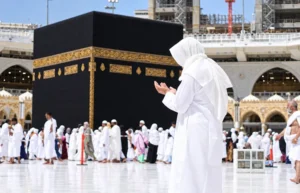
Tawaf means walking around the Kaaba. For Umrah the pilgrim performs seven complete rounds. Before starting, the pilgrim should be prepared according to the requirements of Tawaf. The first round begins at the Black Stone. The pilgrim keeps the Kaaba on the left and walks counter clockwise. Each time the pilgrim reaches the Black Stone, one round is completed.
If reaching or touching the Black Stone is easy and safe then a pilgrim may do so. However there is no need to push or hurt other people. If the area is crowded, the pilgrim can gesture toward it and continue.
Men may perform Idtiba which means leaving the right shoulder uncovered during Tawaf. Men may also perform Raml which means walking quickly during the first three rounds. These practices should not cause harm or inconvenience to other pilgrims.
During Tawaf, pilgrims can make dua or recite dhikr. There is no need to believe that a different fixed dua must be recited for every round. After completing seven rounds, the pilgrim performs two Rak’ahs. This may be done near Maqam Ibrahim but it should not cause crowding or inconvenience.
If praying directly behind Maqam Ibrahim is difficult because of crowds, the prayer can be performed somewhere else in Masjid al-Haram. After the prayer, pilgrims may drink Zamzam and make dua.
What to Recite During Tawaf?
You do not need to learn a separate dua for each round of Tawaf. You can make your own dua or recite the Quran. A commonly recited dua between the Yemeni Corner and the Black Stone is:
رَبَّنَا آتِنَا فِي الدُّنْيَا حَسَنَةً وَفِي الْآخِرَةِ حَسَنَةً وَقِنَا عَذَابَ النَّارِ
“Rabbana atina fid-dunya hasanatan wa fil-akhirati hasanatan wa qina adhaban-nar.”
“Our Lord, give us good in this world and good in the Hereafter and protect us from the punishment of the Fire.”
Step 3: Sa’i Between Safa and Marwa
After Tawaf, the pilgrim performs Sa’i between Safa and Marwa. Sa’i consists of seven laps. The journey begins at Safa and ends at Marwa. Walking from Safa to Marwa counts as one lap. Returning from Marwa to Safa counts as the second. The pilgrims continue until seven laps are completed which end at Marwa.
Pilgrims may make dua and remember Allah during Sa’i. There is no requirement to use one fixed dua for every lap. Men jog between the marked green areas and women continue walking normally. The jogging should be done only when it is safe and practical.
Step 4: Shave Hair or Trim
After completing Sa’i, the final step is to remove some or all of the hair. For men, Halq means shaving the head completely. Taqsir means shortening the hair. Shaving the entire head is considered more virtuous according to the cited guidance.
Women do not shave their heads. They trim a small amount from the ends of their hair. Nusuk currently states an amount of about 1–2 cm for women. Once the hair is shaved or trimmed, the restrictions of Ihram end and the Umrah is complete.
What mistakes should you avoid during Umrah?
First time pilgrims can make mistakes simply because they are unfamiliar with the rituals. Learning the procedure beforehand can prevent many problems.
- One common mistake is crossing the Miqat without entering Ihram when Ihram is required for the pilgrim’s route. A person traveling by air should prepare before reaching the Miqat and follow the instructions given for the flight and route.
- Another mistake is pushing people to reach the Black Stone. Kissing or touching it should never become a reason to harm another pilgrim.
- Pilgrims should also avoid thinking that every Tawaf round has its own compulsory dua. You can make personal dua and remember Allah throughout the Tawaf.
- During Sa’i, remember that the journey starts at Safa and ends at Marwa after seven laps. It is also important to count the laps correctly.
- Do not cut your hair before completing Sa’i. Hair removal is the final step that allows the pilgrim to leave Ihram and complete Umrah.
- Finally avoid arguments or pushing during the Holy journey. Umrah is an act of worship, so patience and good manners are important.
What to do after completing Umrah?
After the hair has been shaved or trimmed, the Umrah is complete and the restrictions of Ihram end. The pilgrim can change out of Ihram clothing and return to normal clothing. They can continue praying in Masjid al-Haram, make dua or read the Quran.
It is also a good time to maintain the spiritual habits developed during Umrah. The journey should not only be about completing the rituals. It can also be an opportunity to improve prayer and remembrance of Allah.
If a person plans to perform another Umrah during the same trip, then the rules for entering Ihram again should be understood before doing so. A pilgrim performing another Umrah from Makkah must go outside the Haram boundary before entering Ihram again.
Conclusion
Learning how to perform Umrah before traveling can help pilgrims complete the rituals with greater ease and confidence.
Umrah begins with entering Ihram and making the intention. It continues with Tawaf, Sa’i and shaving or trimming the hair to complete Umrah.
Pilgrims should also learn the common rules and mistakes before reaching Makkah. Most importantly, Umrah should be performed with sincere intention and patience along with respect for other pilgrims.
Proper preparation allows pilgrims to focus on worship and make the most of their spiritual journey.
Frequently Asked Questions
How long does it take to perform Umrah?
Umrah can take around 3 to 6 hours but the time may vary depending on crowds and walking speed with the pilgrim’s physical ability.
Who can perform Umrah?
Only Muslim men, women, and children can perform Umrah if they meet specific physical, mental, and financial conditions.
Can women perform Umrah alone?
Yes, women can legally perform Umrah without a male guardian (mahram) under the new Saudi government regulations. However, many Islamic scholars have different religious opinions.
When is the best time to perform Umrah?
Umrah can be performed throughout the year, and Ramadan is a good choice for more rewards, but it is a busy time of the year. For better weather conditions, November, December, and January are better options.
Can I perform Umrah more than one time during the same trip?
Yes, a person can perform Umrah more than once during the same trip, but they must enter Ihram again from the appropriate place outside the Haram boundary. Pilgrims should follow the religious guidance properly.